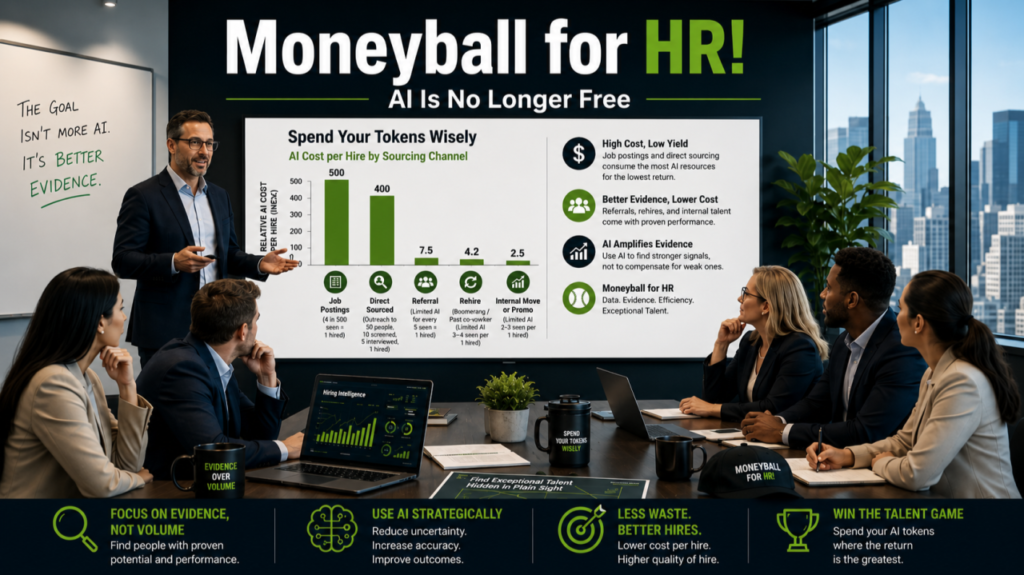

It’s pretty apparent that AI is fast becoming the biggest expense in talent acquisition. Sourcing tools, matching engines, hiring agents, CRM automation, résumé screeners, interview assistants – all priced by seats, credits, tokens, or API calls.
The bill climbs every quarter, yet this Gallup report card on employee engagement suggests the money is ill-spent with only a third of the workforce actively engaged and no improvement in sight.
Every sports team is now using data to find to find better players. “Moneyball for HR!” does the same for hiring by identifying the factors that actually predict future performance.
But here’s the rub. While AI can figure out what are the best predictors, it can’t be used to actually find these the best people. It turns out, that finding and hiring these best people is a high touch relationship based process not an impersonal transaction based on commodity pricing.
Show me the money!
Job postings and direct sourcing are the most AI intensive channels and produce the least value.

A single job posting draws hundreds of applicants. AI screens every résumé, ranks them, matches skills, summarizes backgrounds, answers questions, books interviews. Direct sourcing is slightly better, but it comes with high cost using platforms to identify prospects, enrich profiles, automate and personalize outreach, run campaigns, and track engagement.
Both process enormous volumes of people to produce a single hire. And quality of hire is questionable for the same underlying reason: the AI filters being used are ineffective.
When you know almost nothing about a candidate, AI has to do almost everything.
With the stranger, AI has to infer fit, capability, interest, and odds of success from thin signals. With the former employee or trusted referred, that uncertainty is already gone. They arrive with evidence attached. Someone has already seen how they perform, collaborate, and deliver.
There’s a name for the math doing the AI filtering: Bayes’ positive likelihood ratio, aka, Diagnostic Ratio. And if you have the wrong filters you’ll wind up seeing and hiring the wrong candidates.

AI for hiring misses the strongest talent
Bayesian math measures how hard one piece of evidence pushes the odds: how much more often a strong performer produces that signal than a weak one does. A clue that genuinely separates the two – a track record of comparable results, a trusted colleague’s first-hand account – carries a high ratio and moves the odds a long way in a single step.
Cold channels are expensive because they hand AI almost nothing but ratios near 1 and in the process eliminate some of the strongest people who have a different mix of skills, experiences and competencies.
It’s this second cost that is never seen or budgeted for. A filter that can’t tell a strong candidate from a weak one rejects the strong as readily as the weak – and the best non-obvious people, the ones with an unusual mix of skills and experience, are exactly the ones it discards.
It’s the most expensive mistake in hiring because it’s invisible.
The paradox of the best hires
High touch channels – those yielding the strongest candidates – require the least AI since they’re already prescreened for quality!
Referrals outperform applicants. Boomerang employees ramp faster. Former co-workers can be judged with confidence. Internal candidates come with a full performance history.
These channels deliver what no tool can manufacture – trusted evidence. And that points to a conclusion most companies have backwards.
Raising the bar is a high-touch act
You don’t raise the talent bar by processing more applicants. You raise it by reaching the people who aren’t applying and offer them a real career move – more scope, a harder problem, a genuine step up – not an ill-defined lateral transfer dressed up in a job description.
As I see it, the future belongs the teams that blend high tech with high touch. Let AI do the commodity work: sorting, surfacing, scheduling, the first pass through the noise. Spend the time it frees on the high-touch, consultative work that actually moves a top performer and recovers the Type 2 talent the AI filters threw away.